
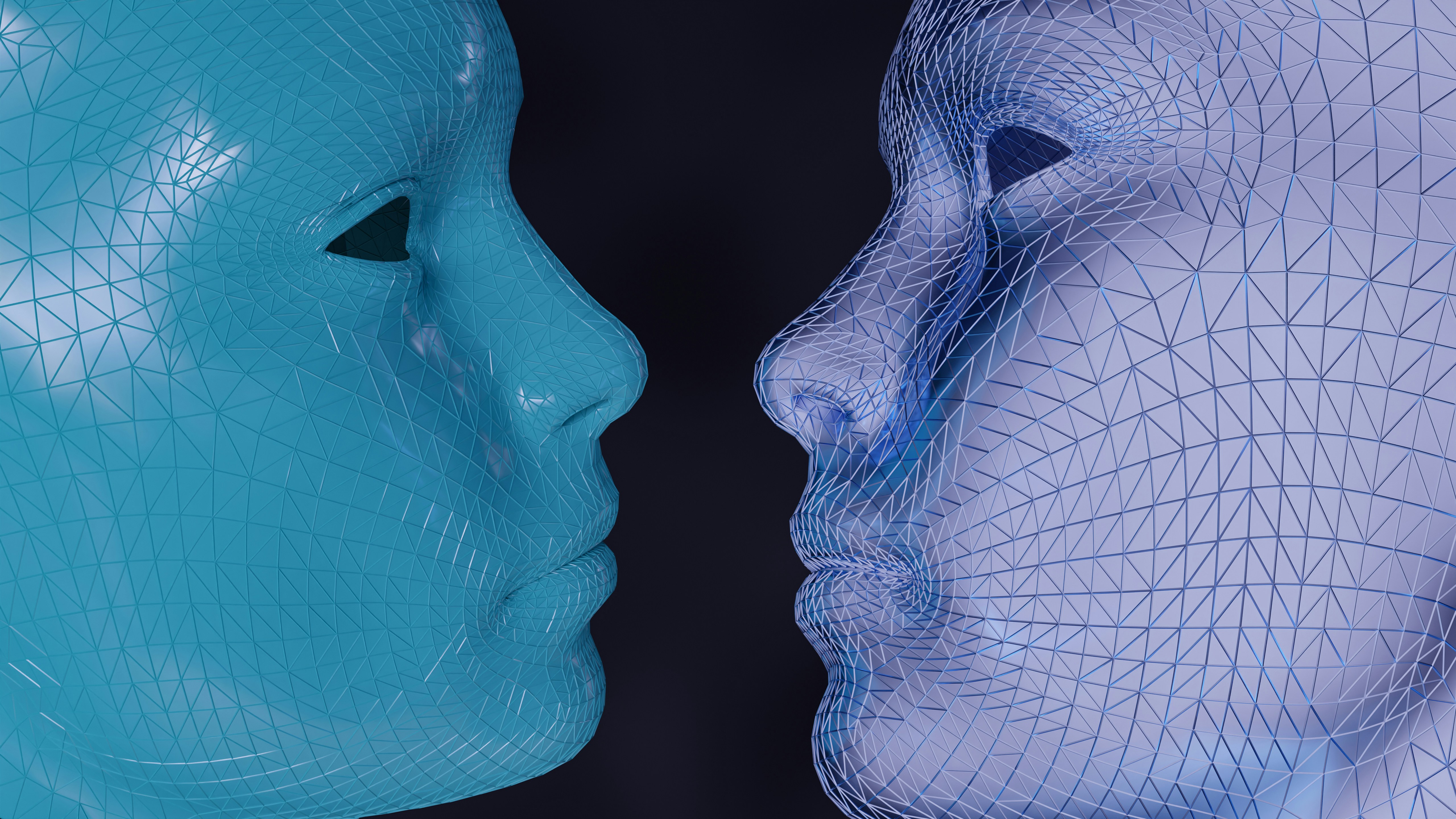
The Nobel Prize in Physics for 2024 was awarded to John Hopfield and Geoffrey Hinton. To the casual observer, conditioned by the recent explosion of generative AI products, this might seem like a category error. Why Physics? The answer lies not in what these models do—generating text or classifying images—but in what they are. At their core, the foundational architectures of modern AI are not merely loose biological metaphors but rigorous physical systems governed by the laws of statistical mechanics.
The Energy Landscape
We often talk about "training" a network as if it were a pedagogical exercise. A more precise physical analogy is relaxation. Consider the Ising Model, formulated a century ago to understand ferromagnetism. It posits a grid of atomic spins, each in a state of up (+1) or down (-1). The system's energy is defined by the alignment of neighbors:
$ E = - \sum_{<i,j>} J_{ij} s_i s_j $
Nature abhors high energy states. A block of iron cools, spins align, and the system settles into a low-energy equilibrium. This is not learning; it is thermodynamics.
John Hopfield's insight in 1982 was to repurpose this thermodynamic relaxation for computation. By connecting artificial neurons in a dense network and defining an energy function similar to the Ising model, he created a system that "remembers." You imprint a pattern by digging a well in the energy landscape. Initialize the network in a noisy state—start the marble at the top of the hill—and it will inevitably roll down into the nearest well, reconstructing the stored memory.
The "learning" here is structurally identical to the phase transition of a magnet. We are not writing logic; we are sculpting energy landscapes.
The Infinite Width Limit
This physical intuition extends beyond the discrete mechanics of the Hopfield network. As we scale modern deep learning architectures, we encounter a startling correspondence with Quantum Field Theory (QFT).
Consider a neural network function ( f(x) ) initialized with random weights. For a given input ( x ), the output is a random variable. As the width of the network tends to infinity, the Central Limit Theorem takes over. The distribution of outputs for any set of inputs converges to a Gaussian Process.
# A conceptual simplification of the Gaussian convergence
import numpy as np

def layer_output(inputs, width):
    weights = np.random.normal(0, 1/width, (width, len(inputs)))
    # As width -> infinity, this sum converges to a Gaussian distribution
    return np.dot(weights, inputs)
This is not a trivial statistical curiosity. In Physics, a non-interacting (free) quantum field is described precisely by a Gaussian distribution of field fluctuations. This implies a duality: a randomly initialized, infinitely wide neural network is mathematically indistinguishable from a free quantum field.
Interaction and Complexity
The correspondence goes deeper. A free quantum field is boring—particles pass through each other like ghosts. Similarly, an infinitely wide network with fixed random weights is a "lazy" learner. The rich complexity of the physical world—and of useful AI—arises from interactions.
In QFT, we handle interactions by adding small perturbative terms to the Gaussian theory (encoded in Feynman diagrams). In Deep Learning, finite width effects introduce similar non-Gaussian corrections. The act of training a finite network moves the statistics away from the simple Gaussian limit, effectively turning "interaction" on. The network learns features not just by memorization, but by interacting with the data structure itself.
We are seeing a convergence of disciplines. Physicists are now using neural networks to denoise gravitational wave signals and simulate the quark-gluon plasma, not merely as black-box tools, but as systems whose statistical properties share a lineage with the phenomena they model. Conversely, the tools of high-energy physics—renormalization groups, phase transitions, and symmetry breaking—are becoming essential for understanding why these massive non-convex optimization problems solvable at all.
A Closing Reflection
There is a tendency to view AI through the lens of biological mimicry—an attempt to recreate the brain. The 2024 Nobel announcement suggests a different, perhaps more fundamental perspective. We are not just building artificial brains; we are engineering complex physical systems that process information through the path of least resistance. The effectiveness of Deep Learning may have less to do with neurons and synapses, and everything to do with the unreasonable effectiveness of statistical mechanics in high-dimensional spaces.