
The Curriculum Problem
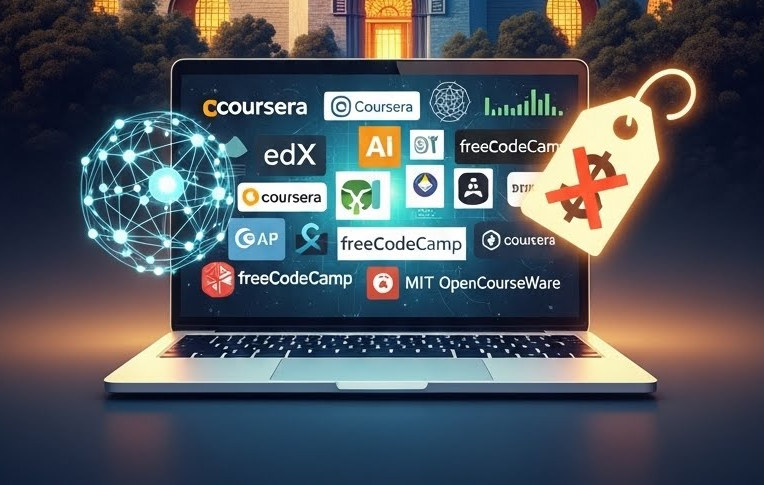
Stanford's AI graduate certificate costs between \$19,000 and \$24,000. The knowledge it delivers, however, exists freely across the internet. The challenge is not access but structure. Most self-learners fail not from lack of resources but from lack of sequencing.
What follows is a reconstruction of that sequence using publicly available materials. The timeline mirrors Stanford's part-time track: one to three years depending on prior background and weekly commitment.
Phase One: Mathematical Foundations
AI without mathematics is pattern matching without understanding. Three areas require attention before touching any model.
Calculus
Derivatives, integrals, and the fundamental theorems. These appear constantly in optimization and gradient-based learning. The chain rule alone underpins backpropagation.
Consider a simple gradient descent update:
$\theta_{t+1} = \theta_t - \alpha \nabla_\theta J(\theta)$
Where $\alpha$ is the learning rate and $\nabla_\theta J(\theta)$ is the gradient of the cost function. Without calculus, this is incantation.
Khan Academy covers this adequately. MIT OpenCourseWare provides more rigor. Budget four to six weeks.
Linear Algebra
Matrix operations, vector spaces, linear transformations. Neural networks are fundamentally matrix multiplications with nonlinearities.
A simple forward pass:
import numpy as np

def forward(X, W1, W2):
    hidden = np.maximum(0, X @ W1)  # ReLU activation
    output = hidden @ W2
    return output
The @ operator is matrix multiplication. If this looks foreign, spend time here. Sheldon Axler's "Linear Algebra Done Right" is excellent. Gilbert Strang's MIT course is free and thorough. Four to six weeks.
Probability and Statistics
Random variables, distributions, conditional probability, Bayes' theorem, linear regression. Machine learning is applied statistics with computational muscle.
Bayes' theorem in its useful form:
$P(H|E) = \frac{P(E|H) \cdot P(H)}{P(E)}$
MIT OpenCourseWare's "Introduction to Probability and Statistics" covers the essentials. The central limit theorem and inference with unknown priors matter more than most tutorials suggest.
Phase Two: Programming Infrastructure
Mathematics provides the theory. Code provides the implementation.
Linux Command Line
Most AI infrastructure runs on Linux. Basic navigation, file manipulation, and shell scripting are prerequisites. Ubuntu's beginner guide suffices. One to two weeks.
Object-Oriented Programming
Data types, control flow, functions, classes. These are not optional. Code Academy offers adequate coverage.
Data Structures and Algorithms
Lists, stacks, sorting, searching. Model optimization often reduces to algorithmic efficiency.
# Binary search: O(log n) vs linear search: O(n)
def binary_search(arr, target):
    left, right = 0, len(arr) - 1
    while left <= right:
        mid = (left + right) // 2
        if arr[mid] == target:
            return mid
        elif arr[mid] < target:
            left = mid + 1
        else:
            right = mid - 1
    return -1
Four to six weeks.
Python and Its Ecosystem
Python is the lingua franca of AI. Google's Python class provides the basics. "Automate the Boring Stuff" offers practical reinforcement.
The libraries matter more than the language:
import numpy as np
import torch
import torch.nn as nn

# A minimal neural network in PyTorch
class SimpleNet(nn.Module):
    def __init__(self, input_dim, hidden_dim, output_dim):
        super().__init__()
        self.fc1 = nn.Linear(input_dim, hidden_dim)
        self.fc2 = nn.Linear(hidden_dim, output_dim)
        self.relu = nn.ReLU()

    def forward(self, x):
        x = self.relu(self.fc1(x))
        return self.fc2(x)
NumPy for numerical operations. PyTorch or TensorFlow for deep learning. Pandas for data manipulation. Budget eight to fourteen weeks total.
Phase Three: AI Fundamentals
Two paths diverge here. Broader AI covers constraint satisfaction, Markov decision processes, graphical models, and logic. Machine learning focuses on algorithms that learn from data.
The machine learning path is more immediately applicable. Start there unless you have specific interest in symbolic AI or robotics.
Core Machine Learning
Supervised learning: given inputs and outputs, learn the mapping. Unsupervised learning: given only inputs, find structure. Reinforcement learning: learn through interaction and reward.
Stanford's CS229 materials are freely available. Andrew Ng's 216-page course notes remain one of the best introductions to the field. His Coursera specialization provides video format if that suits your learning style.
Fast.ai takes a different approach: practical first, theory later. Both work. Choose based on how you learn.
The loss function for linear regression:
$J(\theta) = \frac{1}{2m} \sum_{i=1}^{m} (h_\theta(x^{(i)}) - y^{(i)})^2$
This is mean squared error. Minimizing it gives you the best fit. Gradient descent finds that minimum iteratively.
Projects
Stanford requires project work. Self-study should too. Three directions:
- Apply existing algorithms to new domains
- Develop novel algorithmic approaches
- Explore theoretical properties
Review papers from ICML or NeurIPS for inspiration. Stanford publishes past student projects publicly.
Phase Four: Specialization
Deep learning, computer vision, natural language processing, reinforcement learning, robotics. Pick based on interest and career direction.
Stanford's advanced courses are largely available on YouTube. CS231n for vision. CS224n for NLP. CS234 for reinforcement learning.
A simple convolutional layer for image processing:
import torch.nn as nn

conv_layer = nn.Sequential(
    nn.Conv2d(3, 64, kernel_size=3, padding=1),
    nn.BatchNorm2d(64),
    nn.ReLU(),
    nn.MaxPool2d(2, 2)
)
This takes a 3-channel image and produces 64 feature maps. The pattern repeats with variations across most vision architectures.
Futher Explainations direct resource links by Jean Lee (Founder of Exaltitude) Download here
The Missing Piece
Curriculum completion is not competence. The gap between understanding concepts and building systems is substantial. Projects bridge it partially. Production experience bridges it fully.
The free resources match Stanford's content. They cannot match the peer pressure, deadlines, and networking that tuition buys. Self-study requires self-discipline. Most who start do not finish.
The path exists. Walking it is another matter entirely.