
The field of AI engineering has evolved rapidly over the past several years, driven by a series of breakthrough research papers. Understanding these foundational works provides essential context for the design decisions and trade-offs we face when building production AI systems today.
The Transformer Revolution
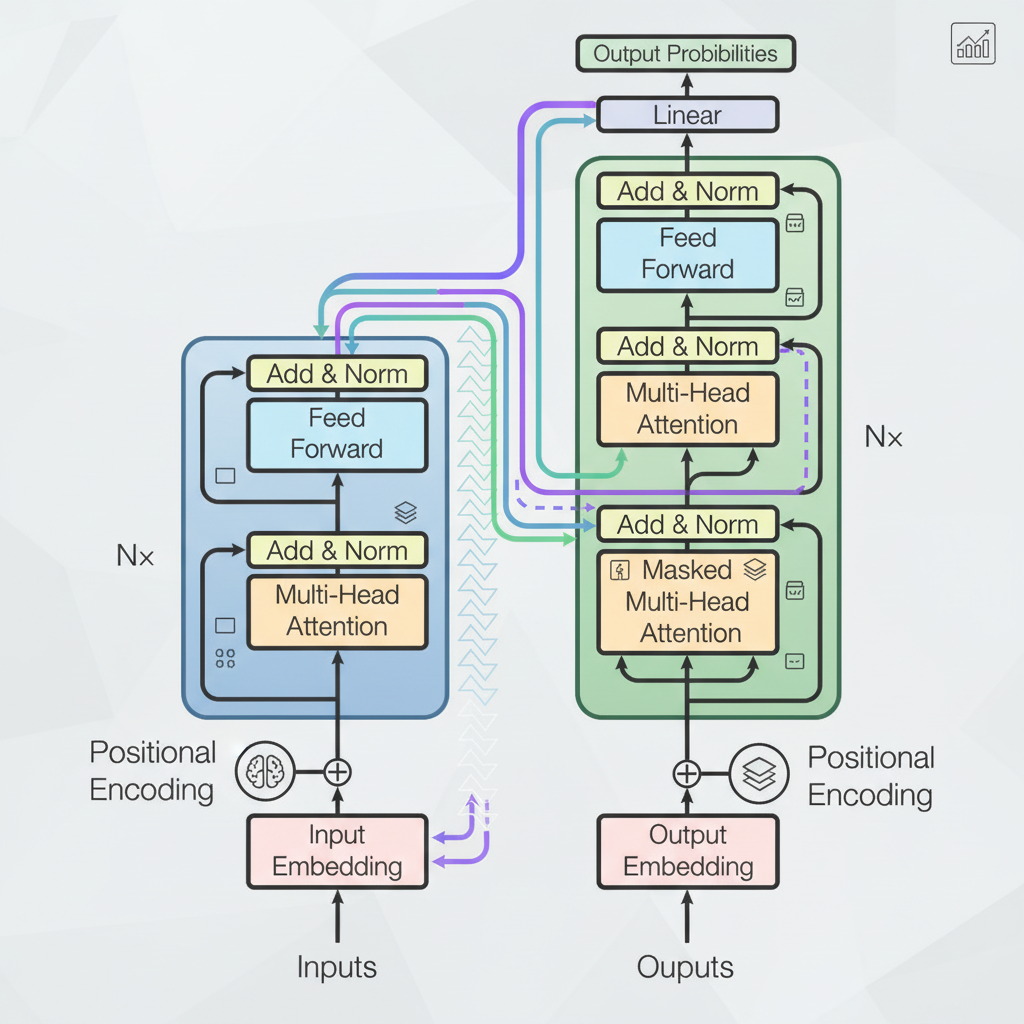
Neural networks have existed since the 1940s, yet their recent prominence stems from a specific architectural innovation. In 2017, researchers at Google published "Attention Is All You Need," introducing the transformer architecture. This paper addressed three fundamental limitations of prior approaches:
Sequential Processing Constraints: Recurrent and convolutional networks processed text step-by-step, creating bottlenecks in training speed.
Long-Range Dependencies: These architectures struggled to connect information appearing far apart in documents.
Parallelization Limitations: The sequential nature made it difficult to distribute work across multiple GPUs effectively.
The transformer's self-attention mechanism allows the model to examine all words in a sequence simultaneously, determining which relationships matter. This enables massive parallelization, improves context handling, and makes scaling more favorable. Nearly every modern language model descends from this design.
Scale and In-Context Learning
The 2020 paper "Language Models are Few-Shot Learners" (GPT-3) demonstrated an unexpected capability: sufficiently large transformer models can perform new tasks from minimal examples provided in the prompt, without task-specific fine-tuning.
The research team trained a large decoder-only transformer and systematically evaluated it across multiple tasks using only prompt variations:
- Zero-shot: Instructions alone
- One-shot: A single example
- Few-shot: A handful of examples
The breakthrough was not architectural. It demonstrated that scale combined with prompting unlocks in-context learning—the model infers tasks from patterns in the prompt itself. This reframed system design: instead of training specialized models for each task, we can often prompt a general model appropriately.
However, scale alone does not solve all problems. Subsequent work revealed the importance of alignment.
Model Alignment Through Human Feedback
The 2022 paper "Training Language Models to Follow Instructions with Human Feedback" (InstructGPT) addressed models that respond unhelpfully or produce toxic outputs. The approach uses reinforcement learning from human feedback (RLHF):
- Supervised Fine-Tuning: Train on examples of desired behavior
- Reward Model Training: Learn to prefer better answers based on human rankings
- Policy Optimization: Adjust the base model to produce answers the reward model prefers
The key finding: a smaller aligned model can outperform a much larger unaligned one because it follows directions and respects user intent. More recent advances include Direct Preference Optimization (DPO), which learns from ranked preferences without an explicit reward model.
Parameter-Efficient Fine-Tuning
While in-context learning and alignment improve model behavior, domain-specific tasks often require fine-tuning. Full fine-tuning updates all model weights, demanding significant compute resources.
The 2021 LoRA (Low-Rank Adaptation) paper provided a practical alternative. Instead of updating all weights, LoRA inserts small low-rank adapter matrices that nudge the large weight matrices in a low-dimensional direction. Only these adapters are trained, keeping the base model frozen.
This results in:
- 10,000× fewer trainable parameters
- ~3× lower GPU memory usage
- Single-GPU fine-tuning feasibility
LoRA transformed fine-tuning from a research project into a practical engineering tool. Combined with quantization techniques, it enables even greater efficiency gains.
Retrieval-Augmented Generation
Language models face a fundamental limitation: they only know what was in their training data. The 2020 paper "Retrieval-Augmented Generation for Knowledge-Intensive NLP Tasks" proposed a solution: before generating an answer, retrieve relevant documents and let the model read them.
This addresses two issues:
Outdated Knowledge: Access information beyond the training data cutoff date
Hallucination: Ground responses in retrieved sources rather than memorized patterns
The pattern has become standard in production systems. However, implementation quality matters significantly. Effective RAG systems require careful attention to:
- Document chunking strategies
- Indexing approaches
- Search ranking algorithms
- Query rewriting techniques
- Multi-step retrieval pipelines
- Faithfulness evaluation
Often, retrieval quality matters more than the specific base model chosen.
Agent Architectures
While powerful models with data access are valuable, they require orchestration to accomplish tasks autonomously. "The Rise and Potential of Large Language Model Based Agents" (2023) surveys the agent design space, proposing a conceptual framework:
Brain: The LLM plans and decides next actions
Perception: The agent reads context—tool results, files, web pages, memory
Action: It executes steps—API calls, tool invocations, writes—then observes results and iterates
The survey covers common patterns: single agents, multi-agent teams, human-agent collaboration, and emergent behaviors in agent societies. Practical considerations include:
- Clear tool schemas
- Guardrails preventing runaway loops
- Result verification mechanisms
- Evaluation methodologies
Sparse Models and Mixture of Experts
The "Switch Transformers" paper demonstrated how to scale to trillion-parameter models efficiently using sparse computation. The mixture-of-experts approach employs many specialized sub-networks (experts), with a router selecting which single expert processes each token.
This conditional computation strategy stores many parameters but activates only a small fraction per token, reducing inference cost while maintaining capacity. The trade-off: serving sparse models introduces engineering complexity around load balancing, latency management, and bottleneck avoidance.
Many teams choose moderately-sized dense models combined with retrieval and tooling, finding the total engineering effort lower.
Model Compression Through Distillation
The 2019 Distil BERT paper showed that knowledge distillation—teaching a smaller student model to mimic a larger teacher—can retain most accuracy at a fraction of the cost.
DistilBERT achieved:
- 40% fewer parameters
- 60% faster inference
- 97% of BERT's language understanding
This matters for edge deployment scenarios with tight latency budgets, limited memory, privacy constraints, or no internet access. Compact models running on devices unlock numerous practical applications.
Quantization for Efficient Inference
Quantization stores model weights using fewer bits (e.g., 8-bit integers instead of 32-bit floats), reducing memory and accelerating computation. The challenge is preserving accuracy.
The 2022 LLM.int8() paper was the first to demonstrate effective quantization at multi-billion parameter scale. The key insight: a tiny number of outlier features—individual channels with unusually large activations—break naive quantization.
The solution uses mixed precision: quantize most features at int8, keep outliers at FP16/BF16. This roughly halves memory for large components while preserving quality, making single-GPU inference feasible for models previously requiring clusters.
Combined with LoRA, this enables efficient task-specific fine-tuning.
Standardizing Model Integration
Anthropic's 2024 Model Context Protocol (MCP) addresses a practical challenge: connecting models to external systems. Rather than hand-coding integrations for each database, API, or tool, MCP provides an open standard.
MCP servers expose tools, resources, and prompts in a standard schema. Any MCP-capable client—IDEs, agent runtimes, chat applications—can discover capabilities, invoke tools, stream results, and maintain shared context.
This standardization reduces integration effort and enables composable AI systems.
Reflections on the Trade-Off Space
These ten papers represent different aspects of the AI engineering challenge: architectural foundations, scaling strategies, alignment techniques, efficiency optimizations, and practical integration patterns.
Several themes emerge:
Scale vs. Efficiency: Larger models offer capabilities, but practical deployment often favors smaller, optimized models with good tooling.
Generality vs. Specialization: General models with prompting compete with fine-tuned specialists. The choice depends on task diversity, data availability, and maintenance burden.
Capability vs. Control: More powerful models require more sophisticated alignment and guardrails.
Research vs. Engineering: Breakthrough papers demonstrate possibilities; production systems require careful attention to retrieval quality, evaluation, monitoring, and operational concerns.
The field continues evolving rapidly. These foundational papers provide context for understanding current systems and anticipating future developments. The engineering challenge lies not just in understanding the research, but in making thoughtful trade-offs when building systems that work reliably in production.